words and words

Hi,
Lately, I’ve felt less sure of what to 'say' about the world. Instead, I find myself trying to document it. To find better — more alive? more accurate? more up-to-the task? — ways of working with words in the face of a reality that grows ever more absurd.
Charlotte Shane published a thoughtful essay on this subject in April titled “Dead Language.”[1]
“In the hours to days to weeks to months that followed Renee Good’s murder, I was beset by an emetic intolerance for words newly written or spoken about the American situation, even those that came from pacifists, Marxists, anarchists, decent people of whatever professed ideology who spoke in anger and anguish,” she wrote. “All expressions felt the same: like ash.”
Yeah, same. She described a process — visceral, emptying — through which language dies:
Factual truth did not give the circulating phrases power or meaning, nor did a speaker’s emotional sincerity, because the words I encountered were not in touch with these sources. They may have been, once, but the vibrant, almost vascular process that occasioned their creation was not active anymore. Now, they were secular catechisms, repeated with...the energetic evacuation that comes with retreat into familiarity. It was sloganeering, even when wordsmithed into ostensibly original speech…
Language had gone dead like a battery or (better) a plant: desiccated and brown yet still composed, holding onto its shape without receiving sustenance. Because the words were as empty as hollow reeds, when they punctured one’s consciousness they drained out sensitivity, clarity, faith in others, faith in self. I felt this lessening in the true sense of the verb, as an embodied experience. And I knew other people were undergoing the same, probably—or especially—the people speaking.
What is to be done? I ask myself over and over. There are many problems with words.
At some moments last year, I felt sure that language was more trap than medicine, tool, or ramp to anywhere. I’m not sitting stubbornly in that place anymore, but where I am, in relation to these questions, is not easy to pin down.
The problems built into words may be small windows that, when opened, invite us elsewhere. Possibilities. But, I’m not sure. I feel a bit like the resident of a swamp, or perhaps the swamp itself — fertile, full of ideas, but not moving quickly in one direction. We’ll see.

Last month, I published a short story at Flaming Hydra on what it was like to get a colonoscopy — and simply live a day — in April, 2026. As I was reviewing edits from the inimitable writer Maria Bustillos, I found myself laughing out loud. This is not to say I succeeded in writing something funny. Rather, to notice myself laughing in the process of writing — this, to me, was a nice indication of some sort of shift, between words and me, under way.
With permission, I’m re-publishing that essay beyond the Hydra paywall below. I hope you enjoy it. (And I hope you subscribe; only $3 per month. A steal!)

One last thing. On the matter of words, I keep returning to a novel I read this summer called Discipline by Larissa Pham, about a painter who quits painting and writes a book in revenge. I recommend it. I also return to an essay by the novelist Rachel Cusk on the artist Kate Millett’s 1972 installation, “Terminal Piece,” which depicts several rows of empty chairs and one female mannequin sitting, all behind bars.
“Encountering Kate Millett’s installation, one immediately registers the failure of language in the face of the need for force,” Cusk wrote. “A text, with its explanatory burden, cannot even occupy the same moment as force. An art work that responds to the violence of living is not required to explain or describe the violence: it can equate itself with it.”
Cusk continued,
The failure of language again: Is it because language is itself a social system and therefore ultimately untrustworthy? Is the art work, with its autonomy and silence, the only place where individual reality can be safely revealed? Yet it is language that defines our humanity: what outraged Millett the most about her institutionalization was that she had been deprived of the opportunity to speak.
…At a Rothko exhibition in Paris, I watched crowds of people standing in front of the big, mysterious canvases, and this distance—between manifestation and description—seemed greater than ever before. I imagine that there were few people there who could have said what the paintings were about, or explained how the works made them feel, any more than I could have. It seemed important not to have to explain: Rothko’s abstraction permitted us, for once, to not have to give an account of ourselves, to reside untroubled in our own mystery.
What do you think?
I have more updates to share and will be back with another letter soon. In the meantime, I continue to read, to work, to do my dishes, and to think.
Sharing my story below. 'Til next time,
k
Expelling Demons (A Colonoscopy)
Republished in partnership with Flaming Hydra (subscribe! subscribe! $3/month)
3 p.m. April 2
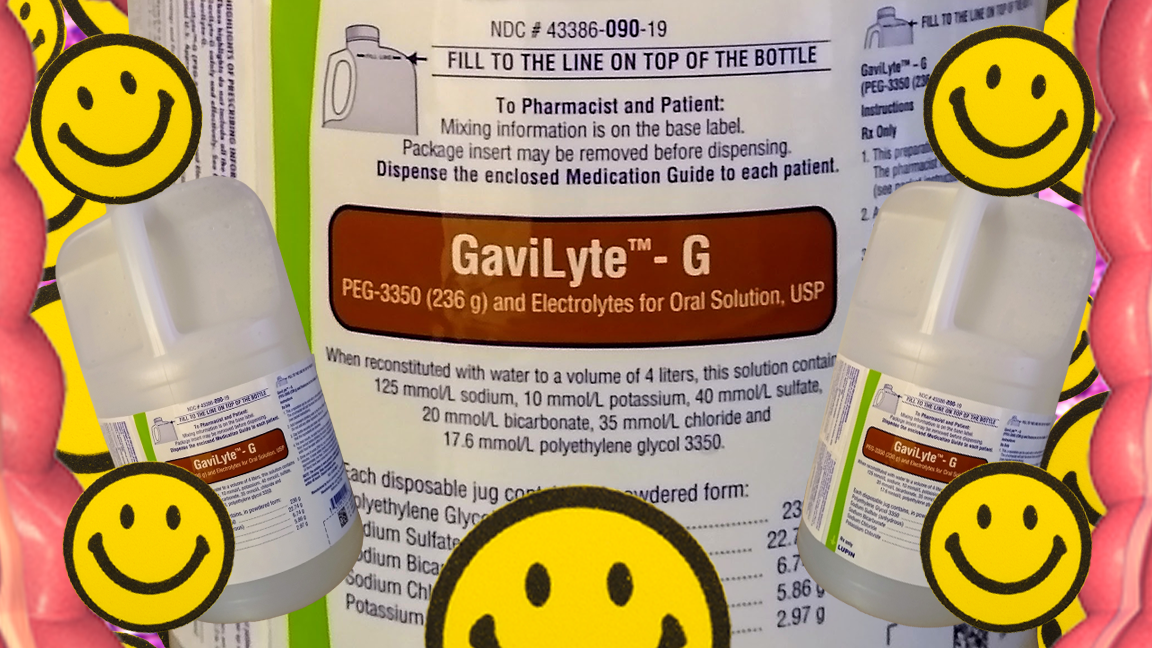
Adults hide many things about adulthood. Like, for instance, the fact of colonoscopies. This is the dreaded test adults over 45 must endure in order to make sure we haven’t got colon cancer. It involves drinking the whole contents of a four-liter jug (1.0567 U.S. gallons) of GaviLyte-G laxative at the rate of eight ounces every ten minutes. At 3 p.m. on April 2, I’d been drinking for an hour, and the amount of GaviLyte-G still remaining to be drunk was dispiriting, to say the least.
Colonoscopy sufferers are required, for obvious reasons, to stay home during the four hours or so it takes to struggle the stuff down.
I poured another cup and sat back down with my straw, my ginger ale, my regular water, my vegetable broth, my lemon slices, and my napkins. Intermittently I ran for the toilet and experienced a sensation I’ve never felt, which can only be described as peeing out of my back end, all while making my headphones noise-cancelling so as to not hear the sensation, which grossed me out more than feeling it; I turned up the volume on a Call Her Daddy interview with reality TV star and former L.A. mayoral candidate Spencer Pratt, who was talking about being a martyr for reality T.V.
I’d seen a preview clip of this interview somewhere, showing Pratt yelling “fuck this” and storming out, mad.
The YouTube video cut out suddenly, so I thumbed to another app and took refuge in an interview with the novelist George Saunders, who has a new book out.
“I can see that it’s going to happen, and it’s going to happen in the way that everything happens,” he said, about death.
6 p.m. April 2
“I talked Brody Jenner into breaking up with his celebrity girlfriend to fake date LC,” Spencer told the Call Her Daddy lady.
In a hypnotic flow with my five drinks, my napkins, and my Gavilyte-G, I finished my dose and set my next timer.
7 p.m. April 2
Ten entries deep into a Reddit thread on psychedelics, OCD, and demons.
“That sounds like the demon I had that was finally exorcised in my last ceremony,” offered redditor iateadonut, explaining how the demon manifested as back pain in “the lumbar, maybe L1 or L2, if i remember correctly,” and later clarifying, “I never learned the demon's name, but it left in November 16, 2024, in Florida, cast into a mosquito.”
Evidently the whole Call Her Daddy fight with Spencer Pratt turns out to have been staged as a joke to attract viewers, though most people on TikTok still seem to think it was real.
11 p.m. April 2
Sleepy, starving, horizontal, idly looking through my email inbox at messages from Chewy.com, Wells Fargo, Amtrak, Mr. Dewie’s Cashew Creamery, and my therapist. Also at several headlines relating to war crimes. Then, a friend replied to a text I sent earlier regarding an article about the spiritual meaning of ants.
I wondered if, eventually, I would disconnect from my body entirely, like a balloon, and float away. At some point, I fell asleep.
6 a.m., April 3
A 45-minute drive to the hospital; the air was cool outside. Inside, the hallway smelled like nothing, with a hint of hand sanitizer.
7:45 am, April 3
On my bed in a row of beds, separated by fabric curtains hanging by little metal hooks. A smiling nurse visited me and left me a tiny paper outfit, completely open in the back. I took off all my clothes, put it on, and got really cold.
“How did the prep go?” the nurse asked cheerfully.
“FANTASTIC!” I shouted, really overstating things. I grinned and projected confidence.
Another nurse brought me a thin blanket.
A man walked into the fabric-walled compartment next to mine. His voice sounded jolly, echoing in a pleasant way.
“How did the prep go?” My nurse also asked him.
“Well, I hope! Ha ha ha,” he said, implying a terror similar to mine at the prospect of having to drink the jug all over again (which you will have to, if your colon is not sufficiently clear).
Next thing I knew, they were pushing me down the hall on this bed with wheels. More nurses passed me and, cheerily, they waved.
8:15 am, April 3
The procedure room is tiny. Some guy, apparently the doctor, asked me what I was going to eat afterwards, and I asked him if there were any limits on that, actually, and he laughed and said have whatever you want.
He instructed me to lay on my side, at which point I realized they were all going to stay in here while a tiny camera attached to a long cord went up my butt which frankly seemed too foolish to be true, so I started giggling and was about to say—but by then I had fallen asleep.
8:45 am I think
I woke up in the recovery room, high as a kite. Everything felt soft. Even my insides. I felt happy, like any other emotional state was no worries, like they’d melted away, like I could really relax, possibly for the first time in years. I’m looking at the ceiling, I’m looking at the hall, I’m wiggling my little toes in those mesh brown hospital socks. Suddenly a nurse arrived, offering me a tiny plastic cup of apple juice. This has to be the crispest coldest apple juice I’ve ever tasted, I either thought, or said aloud. The nurse smiled at me.
Nurses nurses everywhere, walking to and fro. There might be 30 patients in this room, maybe more. Hundreds, possibly. Thousands. One nurse tried to wake up a man across from me. He seemed deep asleep. He appeared to be the same man whom I’d overheard at the beginning; he was older than I thought, grey hair, very tall. Despite this, he slept and stirred in a way that reminded me of a baby.
The doctor arrived and started saying medical facts which meant nothing to me. I wanted to say okay, listen—I am so high—why don’t we slow down, relax, take a load off? But I could grasp the gist: my colon is fine.
My nurse returned with a plastic bag full of my belongings, most of which I hadn’t realized I was missing.
“Can I ask you,” I said, “how do people usually respond to anesthesia?” For me, this stuff always delivers.
“Oh, in so many ways,” she replied, her interest piqued enough to look at me, but not enough to slow her motions, which were steady, unstoppable, she just kept walking around, pressing buttons and noting things, so quick yet so smooth on her feet. “Some people laugh, some people weep,” she said. “They just wake up crying.” She walked away, more tasks ahead.
I peeked into the other fabric compartments and wondered, when was the last time these adults were mothered like this? Everywhere, nurses, everywhere their attentive care. Soft touches to the shoulders, gentle ministrations to our unruly bodies, lock-step attunement to each person’s breath, thirst, hunger, discomfort. A mesmerizing dance I couldn’t stop watching, a dream, a performance, but it wasn’t, it was real life.
My time in bed was up. I didn’t want to leave, but I had to.
I walked from the hospital to a nearby diner, still thinking about the recovery room, and the best apple juice I may ever have, and saying goodbye to my nurse, who was smiling at me, as if in on the joke. I tucked myself dreamily into a leatherette booth and ordered an omelette, a donut, and a big cup of tea.

Makeshift footnotes:
[1] The link to Charlotte Shane's essay, "Dead Language," will take you to a paywall, but it is free to subscribe.